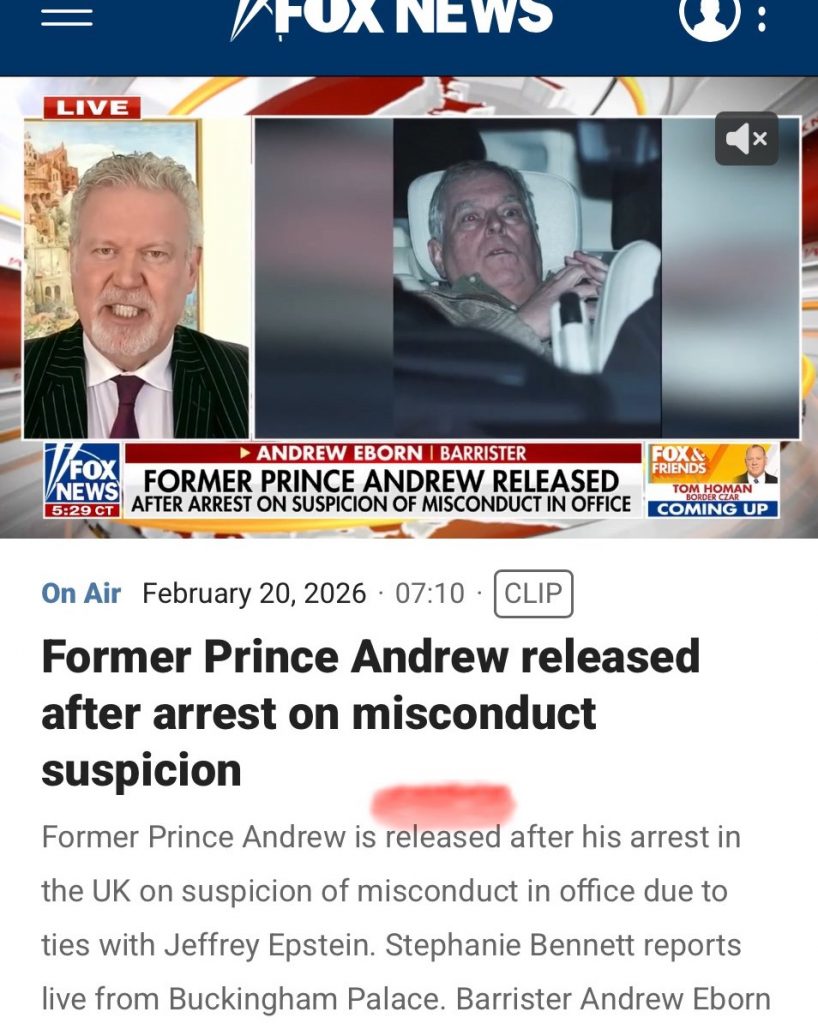
Over the last few days Andrew Eborn has appeared several times on various channels around the world in addition to my regular appearances on Sky News Australia, BBC & Times Radio including CNN, Fox News, CBC ,TMZ and many more.

It is astonishing how many people are reporting the arrest of former Prince Andrew incorrectly. What’s worse is that many are risking being in contempt of Court.
Being both a Lawyer and a Broadcaster, Andrew Eborn is able to provide insight both on the facts and what can be said.

https://www.foxnews.com/video/6389622135112
https://www.cbc.ca/player/play/video/9.7099074
The Veil of Justice: Britain’s Contempt of Court Laws and the Fragile Balance Between Openness and Fairness
LONDON On 19 February 2026, as the world digested the unprecedented arrest of Andrew Mountbatten-Windsor – once Prince Andrew – on suspicion of misconduct in public office, Thames Valley Police appended a single, chilling sentence to its statement: “Please also remember that this case is now active so care should be taken with any publication to avoid being in contempt of court.”
That quiet warning, issued within hours of the first arrest of a senior royal in modern British history, encapsulated a legal doctrine that has shaped British justice for decades and continues to confound foreign observers in the age of instant global broadcasting. Beneath the surface of every high-profile criminal case lies one of the United Kingdom’s most powerful, yet least understood, safeguards: the law of contempt of court.
The Iron Rule: Strict Liability in an Active Case At its heart is the Contempt of Court Act 1981, the statute that codified centuries of common-law principle.
Sections 1 and 2 enshrine the “strict liability rule”: any publication – whether newspaper article, television broadcast, podcast, tweet, or livestream – that creates a substantial risk of serious prejudice or impediment to “active” legal proceedings may be treated as contempt, regardless of intent.
“Publication” is defined expansively: any speech, writing, or communication “addressed to the public at large or any section of the public.”
A single social-media post can suffice. Proceedings become active the moment a suspect is arrested (or a warrant issued, summons served, or indictment laid). They remain active until acquittal, sentence, or discontinuance.
The threshold is deliberately high – “substantial risk,” not mere possibility – and the prejudice must be “serious.”
Yet the rule is absolute in its application: ignorance is no defence. A foreign broadcaster streaming into British homes, or a US podcaster whose episode reaches UK listeners via Spotify, falls squarely within its reach if the content risks contaminating the jury pool.
What Journalists May and May Not Say
Once a case is active, the rules are unforgiving. Media may report basic facts: that an arrest has occurred, the suspected offence, the identity of the accused (unless anonymity is ordered), and the court date.
They may not:
- Suggest guilt or innocence (“the monster who…”)
- Reveal previous convictions
- Publish photographs that could influence identification evidence
- Speculate on evidence not yet aired in open court
- Interview witnesses or victims in a manner likely to affect testimony
- Publish material that vilifies a defendant or creates a “real risk” of jury bias
Fair, accurate, and contemporaneous reports of actual court proceedings enjoy a statutory defence under section 4.
Discussions of matters of genuine public interest are protected under section 5 – provided the risk of prejudice is merely “incidental.”
In practice, during the early stages of a major investigation – precisely the phase in which public curiosity peaks – British reporting often feels skeletal to American eyes.
Where US cable news might dissect every leaked document and past association, British outlets tread with forensic caution.
In the Andrew Mountbatten-Windsor case, even seasoned royal correspondents limited themselves to police statements, the King’s measured words, and historical parallels, stopping short of the kind of narrative embroidery commonplace across the Atlantic.
Historical Roots and Modern Pressures
The doctrine traces to the medieval concept of sub judice -“under judgment”- designed to prevent trial by newspaper rather than by sworn evidence. The 1981 Act was Parliament’s response to growing concerns in the 1970s that sensational coverage was jeopardising convictions. It struck a deliberate balance between Article 10 of the European Convention on Human Rights (freedom of expression) and Article 6 (right to a fair trial).
Yet the digital revolution has tested that balance to breaking point. A single viral post can reach millions before editors even wake.
Social-media users – not just professional journalists – have been prosecuted and imprisoned for contempt.
The Crown Prosecution Service guidance is clear: the same strict liability applies to individuals as to multinational broadcasters.
Foreign media face a particularly awkward position. The law applies territorially wherever the publication reaches the United Kingdom and risks prejudicing British justice. Enforcement, however, remains pragmatic.
A US network with no UK assets is unlikely to face extradition for a contempt matter, yet many responsible international outlets voluntarily geo-block or self-censor to protect their London bureaux and reputations.
We don’t want to test whether the Attorney General’s writ stops at Dover
Recent Safeguards and Looming Reform
October 2025 brought a quiet but significant procedural change: new Criminal Procedure Rules now require parties seeking discretionary reporting restrictions to notify the media directly, giving outlets the chance to oppose undue secrecy.
It was a modest victory for open justice in an era when courts have grown increasingly wary of “super-injunctions” and anonymity creep.
More sweeping reform may be coming. In November 2025 the Law Commission published radical recommendations: shifting the moment proceedings become “active” from arrest to charge, creating clearer categories of contempt, and subjecting the Attorney General’s decisions to bring proceedings to judicial review for the first time.
Part Two of the report is expected later in 2026. Whether a government already wrestling with prison overcrowding and public-order challenges will find parliamentary time remains to be seen.
Why It Still Matters
Critics argue the rules are anachronistic in the internet age, stifling legitimate scrutiny and allowing powerful figures to hide behind legal niceties. Defenders counter that without them, the right to a fair trial – hard-won over centuries – would become illusory.
Juries cannot be sequestered indefinitely; they live in the same information ecosystem as the rest of us.
In the Andrew Mountbatten-Windsor case, the contempt warning served a dual purpose: protecting the integrity of any future trial and signalling to the world that, for all the pomp and circumstance of monarchy, British justice remains blind to status.
The King himself acknowledged as much: “The law must take its course.”
That principle -nobody above the law, yet everyone entitled to a fair hearing – is the quiet genius of Britain’s contempt regime. It does not seek to hide the truth; it seeks to ensure that when truth is finally spoken, it is spoken in court, under oath, and tested by evidence, not by the roar of the global commentariat.
In an age when information travels faster than justice, Britain’s contempt of court laws remain one of the last, stubborn bulwarks against trial by media.
They may frustrate the impatient, but they protect something more precious: the integrity of the verdict that will, one day, be delivered in the defendant’s name. For that, in the end, every citizen – royal or commoner – has cause to be grateful.